Jain catering in Mumbai: how a real Jain kitchen works
Strict Jain spec is not a regular kitchen with the onion left out. The separated prep, the asafoetida calibration, and three questions every host should ask before booking.
The first question every Jain host asks
"Will it actually be pure Jain?" That's the question, and the honest answer for most caterers is: not really. A genuine Jain kitchen is not a regular kitchen with the onion left out. It's a separate prep area, separate utensils, no roots, no fermented ingredients, and a cook who understands the difference between Vaishnav-friendly and strict Jain spec. Most caterers who claim to "do Jain" are offering the former while charging for the latter. That gap matters most on a wedding day, when 60 guests at the Jain tables are watching what gets served from behind the buffet counter.
Mumbai has the second-largest urban Jain population in India: conservatively over 5 lakh adherents in the metro region, concentrated in Malabar Hill, Walkeshwar, Bhuleshwar, Marine Lines, Ghatkopar, and the Andheri corridor. If you're hosting any significant event in western Mumbai, Jain guests are not an edge case. They are reliably present, and they know exactly what real Jain food is supposed to taste like.
Strict Jain vs Vaishnav: the distinction most caterers miss
Not all Jain dietary observance is identical. Vaishnav-friendly cooking skips onion and garlic but allows potato, ginger, beetroot, and other root vegetables. Strict Jain spec eliminates all roots (no potato, no carrot, no ginger root, no beetroot, no turnip) on the principle that uprooting a root vegetable destroys the entire organism including the microbes living within and around it. During Paryushana (the eight or ten-day fast in August–September), some families apply an even stricter spec: no green vegetables, no eggplant, heightened attention to double-checking every ingredient.
At Kravvia, when a booking specifies Jain, we begin the conversation by asking which standard applies. The answer changes what we source, what we cook, and how we label. A potato-free Jain thali requires completely different foundation gravies from a Vaishnav spread, and the sourcing for Paryushana spec needs a minimum 21-day lead time to do properly.
"A Jain kitchen is not a regular kitchen with the onion left out. It is a separate discipline: separate utensils, separate boards, and a cook whose first instinct is to ask, not assume."
How a separate Jain kitchen actually operates
Kravvia maintains a dedicated Jain prep section: separate chopping boards colour-coded for Jain use only, separate deghs (cooking vessels), separate serving ladles, and a cook who shifts into Jain mode for the duration of the Jain prep window. Jain food does not share a surface with non-Jain food at any point in the process. When we cater an event with both Jain and regular spreads, the Jain dishes travel in separate containers and are plated at a clearly labelled, separately staffed counter.
This matters because contamination in Jain catering is not just a flavour issue; it is a sincere dietary and religious violation for observant guests. We have declined bookings where the kitchen logistics at the venue made genuine separation impossible. That is the honest position to take.
Why Jain dal makhani is harder than it looks
Without onion and garlic, the aromatic foundation of a north Indian gravy disappears. The standard Punjabi approach (caramelised onion, fried garlic, ginger base) is where most dals begin. Remove all of that and you're not just omitting ingredients. You're rebuilding the flavour architecture from scratch.
At Kravvia, our Jain Dal Makhani is slow-cooked from the previous evening. The depth comes from a long tomato reduction, cashew paste slow-roasted in butter, kasuri methi, and a finishing of cream added well before service so it integrates rather than floats. Asafoetida (hing) does significant flavour work in Jain cooking precisely because it replaces the savouriness that onion and garlic provide. Used in the right quantity and tempered in fat, it bridges the gap. Used as an afterthought, it dominates. Our cooks are calibrated on this distinction.
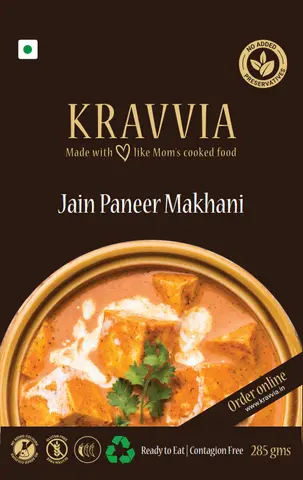
The Jain Paneer Makhani follows a similar rebuild: no onion in the base, the tomato worked longer and harder to develop the sweetness and body that caramelised onion usually contributes. The result is a dish that stands on its own as a proper gravy, not a compromise version.
The Kravvia Jain spread for Mumbai weddings and events
For a 200-guest sangeet or reception, our standard Jain pull-out covers: Jain Dal Makhani, Jain Paneer Makhani, Jain Amritsari Chana, Jain Malai Methi Matar, Jeera Rice, plain paratha, and a dedicated dessert station: moong dal halwa with kesar milk, gulab jamun (confirmed non-fermented syrup), fresh fruit. If the event permits live counters, we run a Jain Chaat Counter (Jain pani puri, Jain bhel with no onion condiments) and a separate Jain pizza option at the pizza counter.
For Jain weddings where the entire guest list observes Jain dietary practice, we reverse the planning process: the Jain spread becomes the main menu, not a parallel section. The starters, the live counters, and the dessert station all run to Jain spec. Non-Jain accommodations (if needed for interfaith family members) are the secondary section.
Corporate Jain catering follows its own logic. A 30-person board lunch in BKC where three of the senior leadership team are strict Jain requires the same kitchen discipline applied at a fraction of the scale: separate containers, clear labelling, staff briefed on which items are Jain and which are not. We handle this as standard for any Kravvia corporate order that specifies Jain coverage.
Booking, pricing, and what to ask any Jain caterer
Jain catering at Kravvia starts from ₹850 per guest for a four-course Jain veg meal, scaling upward with live counters, additional courses, and dessert stations. The Jain specification adds 10–15% to standard pricing: a premium that reflects the sourcing requirements, the separate kitchen protocol, and the additional cook time involved in building flavour without the standard aromatic base.
Lead times: 7-day minimum for Jain catering at events under 100 guests; 14 days for weddings and large events; 21 days for Paryushana-spec bookings. WhatsApp +91 98207 11758 to plan your menu.
When evaluating any caterer for Jain service, ask three things: Can I see the Jain prep area? (Any caterer who does this properly will say yes without hesitation.) What is your contamination protocol when Jain and non-Jain are cooked simultaneously? (The answer should be specific, not vague.) Do you cook Jain food in the same deghs as regular food? (The answer should be no.) If the answers are uncertain or deflected, the Jain guests at your event will notice.
She replies herself, often within the hour.
Peace · Purpose · Progress