Three Numbers That Define Kravvia's Sustainability Case: 12 Months, Zero Cold Chain, One Honest Problem
Retort ships ambient, wastes nothing over 12 months, and faces one real recyclability gap in India's 2026 infrastructure. The full audit.
The audit starts with three numbers
12 months. Zero refrigeration. ₹160–200 per pouch. Those three figures frame every sustainability claim Kravvia can honestly make about its retort line, and one claim it cannot. This piece runs all three to ground, then addresses the recyclability question that the Indian packaging sector is still working through in 2026.
Priti S Shah launched the Kravvia retort line in 2022 after 23 years of catering weddings and corporate events across Mumbai. The logic was distribution: a catering operation that could serve 600 guests at a Juhu wedding could not serve a Kravvia regular who relocated to Bangalore. Retort sterilisation solved that. Sustainability happened to follow.
Claim one: ambient-temperature shipping eliminates the cold-chain emissions segment entirely
Cold chain (the refrigerated truck, the temperature-controlled warehouse, the last-mile insulated delivery box) is a significant emissions contributor in the food logistics stack. The precise figure varies by route length, vehicle age and power source, but the direction is unambiguous: moving a kilogram of frozen food from Mumbai to Hyderabad requires meaningfully more energy than moving the same weight at ambient temperature.
Retort food ships at room temperature because the retort sterilisation process (121°C or above, sustained until the thermal death curve is satisfied) eliminates microbial load inside the sealed multi-layer pouch before the product leaves the facility. There is no pathogen to control in transit, so there is no cold chain to run.
Kravvia's 13 SKUs (9 mains, 2 rice, 1 dessert, with 4 Jain-compliant variants) all carry a 12-month shelf life at room temperature, away from direct sunlight. A consignment moving pan-India via standard surface freight generates the same cold-chain emissions as any other ambient consumer good: zero. The refrigerated segment of the logistics chain is simply absent.
This matters most at distance. A frozen product shipped from Mumbai to Pune involves a few hours of cold chain. The same product to Ahmedabad, Bengaluru or Jaipur multiplies that exposure. For an NRI order routed to a family address in Chandigarh, the gap between ambient and frozen logistics is substantial. Retort closes it in one structural move.
Claim two: 12-month shelf life collapses the food waste equation
Food waste enters the supply chain at several points: the production run that overshoots demand, the retail unit that doesn't turn before its expiry, the household portion that doesn't get eaten before spoilage. Shelf life is the single most powerful variable controlling all three.
Compare the three mainstream formats at the category level.
Frozen ready meals
Typical shelf life in commercial frozen ready meals runs 12–18 months from the date of manufacture, but that window is contingent on the cold chain never breaking. A power cut at the warehouse, a delay at customs for an export shipment, or a consumer freezer operating below spec can accelerate deterioration. The product's nominal shelf life and its actual shelf life diverge whenever the cold chain is imperfect. In India, where cold-chain infrastructure outside the six largest metros remains uneven, that divergence is material.
The waste consequence: frozen SKUs that leave the cold chain, even briefly, must be written off. Retailers and distributors carry shrinkage allowances for this. The consumer who lets a frozen portion thaw and doesn't use it within the narrow refreezing window discards the whole unit.
Ambient canned food
Steel cans achieve similar thermal sterilisation to retort pouches and carry shelf lives of 2–5 years. On the waste and cold-chain dimensions, cans and retort pouches perform comparably. The differences surface in weight (a filled steel can is significantly heavier per gram of food than a retort pouch, which increases fuel burn per unit shipped), end-of-life recyclability (steel cans recycle in a single-material stream; multi-layer pouches do not, addressed in claim three), and flavour retention at the long end of the shelf life (the pouch, with no metal-ion migration, tends to hold a cleaner flavour profile).
Retort pouches
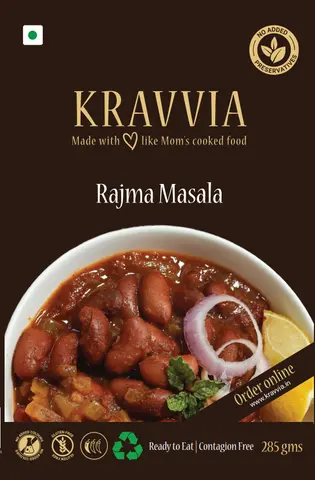
The Kravvia retort line carries a 12-month shelf life unconditionally: no cold chain, no power dependency, no window that narrows if a warehouse loses temperature overnight. A pouch of Rajma Masala packed in January is the same product in January of the following year, stored in a Bengaluru flat or a Patna pantry or a Mumbai office drawer. The shelf life is not nominal; it is actual, because no external infrastructure is required to maintain it.
The food-waste implication: a household that keeps retort pouches has a fallback meal with a 12-month runway. They are not racing a four-day refrigerator window. They are not writing off a forgotten frozen bag. The spoilage rate for properly stored retort products across the shelf life is, by the physics of the process, zero.
At the production end, retort manufacturing can be run to order in a way that frozen production cannot. Frozen SKUs require a filled cold room before distribution. Retort SKUs can move from production line to ambient warehouse to consignment without the cold-room buffer. This reduces the overproduction incentive that drives waste in the frozen segment.
Claim three: multi-layer pouch recyclability in India, the honest answer
This is where the sustainability audit has to be precise rather than reassuring.
Retort pouches are multi-layer laminates. A typical construction runs polyethylene terephthalate (PET) on the outside for structural integrity and printability; an aluminium foil barrier layer in the middle that blocks oxygen, moisture and light; and a food-contact polyethylene or polypropylene layer on the inside. Some constructions add a nylon layer for puncture resistance. Each layer performs a specific function: remove any one of them and the product either fails the retort process or deteriorates within weeks.
The structural requirement that makes retort pouches effective, the lamination of dissimilar materials, is exactly what makes them difficult to recycle. Mixed-material laminates cannot be processed in the single-stream recycling infrastructure that handles PET bottles or HDPE containers. The materials cannot be separated at normal municipal recycling facilities.
In 2026, the honest position for multi-layer retort pouches in India is this: kerbside or municipal recycling is not available for this material in most cities. Dedicated multi-layer plastics recyclers do exist (several operate in Maharashtra), and extended producer responsibility (EPR) regulations under India's Plastic Waste Management Rules require producers to register and account for their plastic waste. Kravvia's production runs in FSSAI-licensed partner kitchens and operates under EPR compliance. But consumer-level take-back infrastructure for multi-layer pouches is still thin. A Kravvia pouch, once used, is most likely going to landfill or incineration unless the consumer actively routes it to a specialised recycler.
That is the gap. It is not unique to Kravvia. It is a category-level infrastructure gap across the Indian food-packaging sector. The alternatives each carry their own trade-offs: steel cans are heavier (more transport emissions per unit), glass jars are heavier still and carry breakage risk in pan-India shipping, and rigid plastic containers are single-material but require cold-chain support or a very different process technology. None of the competing formats is environmentally neutral.
The comparison that holds up: a retort pouch sent to landfill has already eliminated cold-chain emissions and food-waste losses. A frozen meal in a single-material tray that required refrigerated logistics and had a 20% category spoilage rate may have a worse net environmental account even if its end-of-life material is more recyclable. The full-lifecycle picture does not resolve cleanly to a single winner, but it does require honesty about where the retort format has real advantages and where it does not.
Industry-level work on mono-material retort pouches, structures that achieve adequate barrier properties from a single polymer family and can therefore enter standard recycling streams, is active in 2026. No mainstream food product has adopted it at scale yet. When the material technology is ready and FSSAI-approved for food contact, Kravvia will be in a position to transition. Until then, the pouch is what it is.
The buyer's logic in 2026
For a host stocking a Powai pantry, a corporate gifting manager building a Diwali box, or an NRI shipping food to a family address in Jaipur, the retort line's sustainability profile breaks down like this:
- Cold-chain emissions: eliminated. No refrigerated logistics required to any Indian address.
- Food waste: near-zero over a 12-month window. Buy it, store it at room temperature, eat it when you need it.
- End-of-life recyclability: limited in most Indian cities in 2026. The pouch likely goes to landfill. That is the honest answer.
On two of the three axes, retort outperforms frozen and refrigerated alternatives at the category level. On the third, it is in the same difficult position as most Indian packaged food. Kravvia will not claim otherwise.
Pricing and ordering
Kravvia's retort SKUs are priced at ₹160–200 each, depending on the dish. Festive boxes (curated combinations of mains, rice and dessert) start at ₹2,400 for a 12-pack. Corporate Diwali boxes start at ₹3,500. Pan-India shipping runs on standard courier, no cold chain required.
WhatsApp Priti at +91 98207 11758 for festive box quotes or pan-India shipping.
She replies herself, often within the hour.
Peace · Purpose · Progress