Pan-India Ready-to-Eat Shipping Without a Cold Chain: What 12-Month Ambient-Stable Retort Food Unlocks
13 SKUs. 12-month shelf life. No refrigeration. Kravvia's retort line ships pan-India to tier-2 cities, defence canteens, IT campuses, and NRI households.
13 SKUs. One constraint removed.
Twelve months. Room temperature. No preservatives. Those three facts determine what Kravvia's pan-India ready-to-eat shipping actually means in practice, not as a marketing claim but as a logistics reality. When a pouch weighing under 350 grams can sit in a courier bag, a post-office shelf, or an Amazon fulfilment centre for twelve months without refrigeration, the distribution map expands by an order of magnitude. Tier-2 cities. Defence canteens in the Deccan. IT campus pantries in Hyderabad and Bengaluru. NRI households in the UK and North America reachable via Indian courier aggregators. None of these were viable with a cold chain dependency.
The cold chain has been the principal structural constraint on premium vegetarian convenience food in India for two decades. Not availability. Not interest. Not price sensitivity. Infrastructure. A courier that cannot guarantee temperature integrity from Mumbai to Bhopal cannot carry frozen dal makhani. A defence canteen in a remote posting cannot run cold storage for meal components. An NRI ordering food for their parents in Nashik cannot trust overnight refrigerated delivery to land in usable condition. Retort sterilisation removes the refrigeration variable entirely. The food in a Kravvia pouch sits at room temperature from the moment it is sealed to the moment it is opened on a kitchen counter in Ahmedabad or Lucknow.
What cold-chain dependency cost the Indian vegetarian convenience market
The Indian ready-to-eat market's cold chain problem is not about technology gaps. Industrial cold chain infrastructure exists. The problem is last-mile cost and fragmentation. A refrigerated truck from Mumbai to a tier-1 distribution hub is commercially viable. Refrigerated last-mile delivery from that hub to a household in a tier-2 city, at a price point the consumer accepts for a meal that costs ₹160–200, is not. The unit economics break before they reach the consumer.
The result has been a bifurcated market: frozen products concentrated in metro modern trade where cold shelves are a given, and ambient products that sacrificed quality to achieve shelf stability through high sodium, artificial preservatives, or processing intensity that erased the original recipe's character. A dal makhani that requires a cold chain to stay edible is a metro product. A dal makhani that holds at ambient temperature for twelve months with no preservatives and no flavour compromise is a national product.
Kravvia's retort line entered production in 2022. The technical basis is retort sterilisation: the filled, sealed multi-layer pouch is subjected to heat and pressure in a retort vessel at temperatures above 121°C for a controlled cycle time. The process achieves an F0 value, the measure of thermal lethality referenced to 121°C, sufficient for commercial sterility. No preservatives are added because the sterilisation cycle itself eliminates the microbial load that causes spoilage. The pouch's multi-layer barrier (PET, aluminium, nylon, polyethylene in sequence) prevents oxygen ingress, light transmission, and moisture exchange over the twelve-month window. The food inside, once sealed and sterilised, lives in a closed system.
The logistics math
A single Kravvia retort pouch weighs between 280 and 330 grams gross, including packaging. At that weight, a 6-pouch order sits under 2 kg. A 12-pouch order stays under 4 kg. Both fall within standard courier weight bands for road and air freight across India: no special handling category, no temperature-controlled consignment note, no cold chain surcharge.
The practical consequence: the pouch ships exactly like a book, a phone case, or a packet of dry goods. India Post, standard private courier networks, and e-commerce fulfilment platforms all move ambient parcels at established, low per-kg rates. The shipper files no special documentation. The warehouse needs no cold room. The last-mile rider delivers it alongside everything else in their bag. The cost of getting one pouch to a household in Indore or Coimbatore is determined by weight and distance, not by whether the temperature at every handoff was logged and certified.
For NRI shipments via Indian courier aggregators serving diaspora communities in the UK, North America, and the Gulf, ambient stability matters further: international parcels can sit in customs for days. A refrigerated product in customs is a liability. An ambient-stable retort pouch in customs is a waiting parcel. The shelf life buffer of twelve months absorbs customs delays without affecting the food.
Who this opens distribution to
Tier-2 and tier-3 cities
Cities like Nashik, Aurangabad, Nagpur, Surat, Rajkot, Jaipur, and Lucknow have households with the income and the interest to purchase restaurant-quality convenience food. What they have lacked is reliable access: modern trade penetration is lower, cold-chain last-mile is sparse, and direct-to-consumer food delivery from Mumbai restaurants hits a hard distance wall. A retort SKU at ₹160–200 per pouch, delivered via standard courier in four to seven days, clears all three barriers. The food arrives. It sits in the pantry. It is ready four minutes after the decision to eat it is made.
Defence canteens and mess facilities
Defence establishments, particularly those in remote postings, operate institutional kitchens that feed large numbers of personnel under procurement and storage constraints very different from urban food service. Cold storage space is finite and allocated to essential perishables. Ambient-stable meal components that meet FSSAI standards and carry a verified shelf life are a natural fit for institutional procurement where bulk ordering, long lead times, and ambient storage are the norm. Vegetarian coverage matters here: a significant proportion of defence personnel follow vegetarian diets for religious, cultural, or personal reasons. Kravvia's 13-SKU line (9 mains across Punjabi, Awadhi, and Mumbai street food registers, 2 rice, 1 dessert, with 4 Jain SKUs) covers the breadth an institutional menu requires.
IT campus pantries
Large IT campuses in Bengaluru, Hyderabad, Pune, and Chennai maintain staffed cafeterias, but also stock pantries for teams working late, clients arriving at short notice, or employees who want a meal outside cafeteria hours. A pantry shelf stocked with Paneer Makhani, Dal Makhani, Rajma Masala, and Veg Pulao (all ambient-stable, produced in FSSAI-licensed partner kitchens, all ready in 90 seconds via microwave) requires no cold storage, no daily restocking, and no wastage management for perishables. The pantry manager places one order per quarter. The food sits on the shelf until it is needed. The company's vegetarian employees, including those on Jain diets, have a credible meal option at any hour.
NRI households and gifting
The NRI use case divides into two distinct flows. The first is direct purchase: an Indian-origin household in the UK, Canada, or the Gulf buys pouches through an Indian e-commerce aggregator, ships them as part of a consolidated parcel, and stocks them in their own pantry. The second is gifting: an NRI sends a Kravvia box to parents or relatives in India, selecting the retort line because it ships easily, stores without effort, and delivers a specific quality of food the recipient would not otherwise have access to. Festive boxes combining retort mains with Kravvia mithai ship from Mumbai to addresses across India for Diwali, Rakhi, or Eid at price points from ₹2,400 upward.
The NRI gifting case has one additional dimension: provenance. A food gift that comes from the same house that has catered Mumbai weddings for 25 years, founded by Priti S Shah in Santacruz in 1999, carries a different weight than a generic ready-to-eat brand. The retort line is not a concession to convenience. It is Kravvia's catering, in a pouch: the same dal makhani recipe, the same six-hour simmer, the same ingredients, sealed and sterilised for the twelve-month journey.
The 13-SKU line in distribution terms
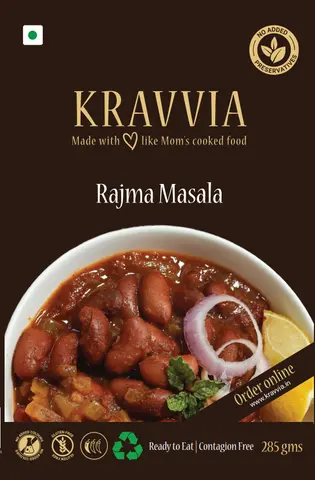
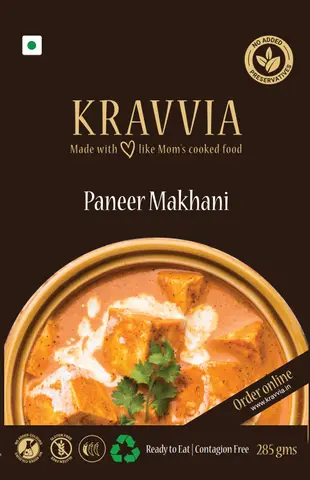
Kravvia's retort range as of 2026: Dal Makhani (₹190), Jain Dal Makhani (₹190), Paneer Makhani (₹190), Jain Paneer Makhani (₹190), Paneer Darbari (₹190), Amritsari Chana (₹160), Jain Amritsari Chana (₹160), Rajma Masala (₹160), Pav Bhaji (₹160), Jain Malai Methi Matar (₹190), Veg Pulao (₹160), Jeera Rice (₹160), Moong Dal Halwa (₹200). Four of the thirteen (Jain Dal Makhani, Jain Paneer Makhani, Jain Amritsari Chana, Jain Malai Methi Matar) carry full Jain specification: no onion, no garlic, no root vegetables at any stage.
Every SKU heats in four minutes in a pan or 90 seconds in a microwave. Every SKU stores at room temperature, away from direct sunlight. Every SKU carries a printed FSSAI licence number, a manufacturing date, an expiry date, a full ingredient list, and serving instructions on the pack. Nothing is omitted from the label in the hope the buyer won't notice. The ingredient list is part of the product.
Pricing and order structure
Individual SKUs run ₹160–200 depending on protein. A 12-pack festive box, mixing mains and rice, starts at ₹2,400. Corporate Diwali boxes built around the retort line and Kravvia mithai start from ₹3,500 per box, with custom pack options for bulk orders. Pan-India shipping is standard; no cold-chain premium applies. Lead time for standard orders is 3–5 business days from Mumbai.
WhatsApp Priti at +91 98207 11758 for festive box quotes or pan-India shipping.
She replies herself, often within the hour.
Peace · Purpose · Progress