Four SKUs, Eleven Months In: How Kravvia Engineers a Jain Retort Dal That Holds
Four Jain SKUs. Twelve months shelf life. No onion, garlic, or root vegetables, and no loss of flavour at month eleven. The engineering behind the pouch.
Four SKUs, Eleven Months In, and the Dal Hasn't Moved
121°C. That is the sterilisation temperature at the core of every Kravvia retort pouch. The sealed multi-layer bag goes into the autoclave; pressure and heat kill spoilage organisms; the contents emerge shelf-stable for twelve months at room temperature with zero preservatives. That part is standard food science. What is not standard, and what most vegetarian retort lines do not attempt, is doing it for a Jain kitchen.
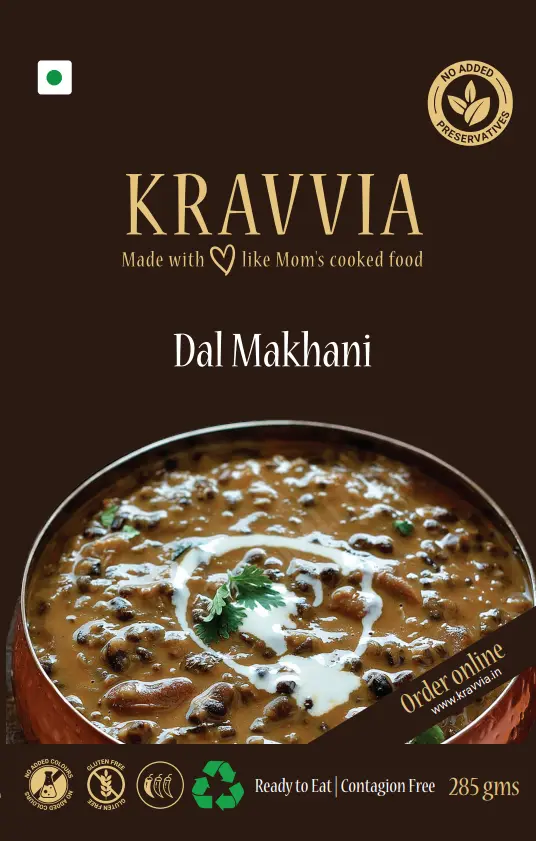
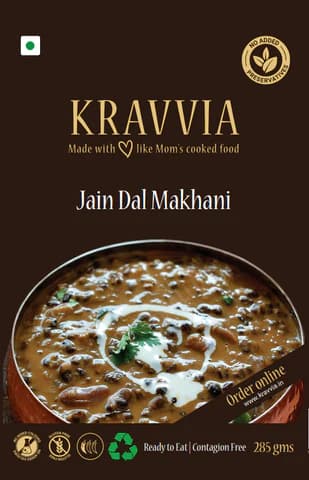
Kravvia ships four Jain-specification ready-to-eat SKUs: Jain Dal Makhani, Jain Paneer Makhani, Jain Amritsari Chana, and Jain Malai Methi Matar. All four carry a twelve-month shelf life. All four contain no onion, no garlic, no root vegetables at any stage of cooking. All four hold flavour integrity at ambient temperature, verified pouch by pouch, from the day of manufacture to month eleven.
The engineering question behind those four SKUs is worth examining. Why is Jain retort scarce? What replaces onion-garlic depth in a sealed pouch that will survive sterilisation at 121°C? And why does the heating protocol stay exactly the same as the non-Jain range?
Why Most Commercial Vegetarian Lines Don't Attempt Jain
Jain dietary practice excludes onion, garlic, and all root vegetables (potatoes, carrots, beets, radishes, turnips) on the reasoning that harvesting roots kills the plant and disturbs soil micro-organisms. For a retort food manufacturer, this is not merely a recipe constraint. It is a structural engineering problem.
In North Indian cooking, the onion-garlic base (known in commercial kitchens as the base masala) performs three technical functions. First, it builds Maillard browning: the caramelisation of onion sugars over a high flame generates the dark, savoury foundation of a dal makhani or chana. Second, it provides body: blended cooked onion thickens a gravy without starch, creating the mouthfeel that cream and tomato alone cannot replicate. Third, it acts as a flavour binder: garlic compounds (allicin, diallyl disulfide) integrate the spice layer into the base during cooking and persist through sterilisation.
Strip all three out and you do not get a simpler dish. You get a broken dish: thin gravy, flat spice, no depth. The commercial solution most manufacturers reach for is to quietly add onion powder or garlic extract and label the product "Jain-inspired." A retort facility running millions of pouches a month cannot afford to retool a line, redesign a recipe from scratch, and validate a new F0 value for a niche SKU. The economics don't close.
Kravvia's situation is different. Priti S Shah has been running a fully isolated Jain kitchen inside her catering operation since 2012: a dedicated space where no onion or garlic enters, not even in a neighbouring pot. The Jain retort SKUs are not adaptations of a non-Jain recipe. They are the catering kitchen's Jain recipes, engineered for a sealed pouch.
The Fat-and-Spice Architecture That Replaces Onion-Garlic Depth
The Kravvia Jain retort range solves the three missing functions (browning, body, binding) through a specific fat-and-spice architecture. No proprietary process names. No invented acronyms. The techniques are correct generic cooking chemistry applied at catering scale.
Tomato as the Browning Agent
Without onion to caramelise, the Maillard browning function falls to tomato. The tomatoes are cooked down, far further than a standard gravy, until the water drives off and the fruit solids begin to darken on the pot surface. This tomato reduction builds the colour and the savoury base note that onion would otherwise provide. In the Jain Dal Makhani, this step takes significantly longer than in the standard version; the tomato paste that results is closer to a concentrate than a sauce.
Cashew for Body
Blended cooked onion is replaced by soaked cashew paste. Cashew, allowed under Jain dietary rules, carries fat, protein, and natural emulsifiers that bind the gravy and provide the thickness and sheen a non-Jain version would derive from onion. In the Jain Paneer Makhani and Jain Malai Methi Matar, cashew paste is the structural backbone of the gravy alongside cream. In the Jain Amritsari Chana, where the original recipe's body comes more from the chana itself than from a thick gravy, cashew plays a supporting role.
Butter and Cream as the Finish Layer
Both butter and cream survive retort sterilisation with their fat matrix intact. In the non-Jain range, butter and cream are finishing elements layered over a garlic-forward base. In the Jain range, they carry more of the flavour load: the fat conducts the spice compounds into the gravy and provides the mouthfeel that would otherwise come from a deeper onion-garlic foundation. The ratio of butter and cream in the Jain SKUs reflects this: the finish does more work.
The Jain Spice Blend
Garlic's binding function, integrating the spice layer into the base, is addressed through spice selection and sequencing. The Jain spice blend used across all four SKUs is calibrated for a no-allium kitchen: asafoetida (hing) in precise quantity provides the sulphurous depth that garlic would otherwise deliver, while cumin, coriander, dried fenugreek (kasuri methi), and a careful balance of warming spices (cardamom, clove, pepper in the makhani variants) build the aromatic range. The sequencing (which spices go into hot fat first, which are added late) is adjusted for the fact that sterilisation at 121°C will flatten volatile aromatics. Late-added spices that would normally provide brightness in a live catering kitchen are loaded more heavily to compensate for what the autoclave takes out.
In the Jain Amritsari Chana specifically, the anardana (dried pomegranate seed) is the primary tartness note, a role shared with onion-tomato in the standard version. Anardana carries its acidity through retort sterilisation reliably, which makes it a technically sound choice for a sealed pouch.
The F0 Value and Why the Heating Protocol Is Identical
Retort sterilisation is measured by the F0 value: the equivalent lethal effect at 121.1°C relative to the most heat-resistant target organism. FSSAI mandates minimum F0 values for shelf-stable pouched foods; Kravvia's production meets those thresholds for all 13 SKUs. The Jain SKUs are not processed differently from the non-Jain range: same temperature, same pressure cycle, same F0 target. The absence of onion and garlic does not change the thermodynamics of sterilisation. Clostridium botulinum does not negotiate on the basis of Jain dietary law.
The multi-layer pouch structure (PET outer layer for structural integrity, aluminium foil barrier layer for oxygen and light exclusion, polyethylene inner layer for food contact) is the same across the entire range. The barrier properties that keep the Jain Dal Makhani shelf-stable for twelve months are identical to those keeping the non-Jain Dal Makhani shelf-stable. The pouch does not know the recipe inside it.
This is why the heating protocol is unchanged: four minutes in a pan on a low flame, stirring occasionally, or ninety seconds in a microwave on high in a bowl. The pouch is torn open, the contents emptied into the vessel, and heat is applied. The Jain Dal Makhani behaves exactly as the Dal Makhani does on the heat source. No separate instructions. No Jain-specific handling note on the back panel.
The Four SKUs: What's in Each Pouch
- Jain Dal Makhani: Whole urad dal, slow-simmered. Tomato cooked to a deep concentrate. Cashew for body. Butter, cream, kasuri methi for the finish. No onion, garlic, or root vegetables. ₹190 per pouch.
- Jain Paneer Makhani: Paneer in a slow-roasted tomato and cashew gravy, finished with butter, cream, and dried fenugreek. The gravy's body comes entirely from tomato reduction and cashew paste. No onion, garlic, or roots. ₹190 per pouch.
- Jain Amritsari Chana: Whole Kabuli chana in a root-vegetable-free dark masala. Tea-leaf for colour; anardana for tartness; ginger juliennes for cut. The Punjab original's character intact. ₹160 per pouch.
- Jain Malai Methi Matar: Fresh methi blanched before it meets the cream gravy (bitterness managed, depth kept). Green peas, cashew paste, tomato, cream. No onion, garlic, or roots. A staple on Kravvia's Jain wedding catering menus for two decades. ₹190 per pouch.
Who Buys the Jain Retort Range and Why
The buyer profile is specific. Jain households in Mumbai (Andheri, Vile Parle, Santacruz, Ghatkopar, South Bombay) stock the pouches as a reliable fallback for days when a full kitchen session isn't possible. For anyone searching for a Jain ready to eat dal makhani that carries a verifiable no-onion-garlic-no-roots specification, Kravvia's retort line, produced in FSSAI-licensed partner kitchens, is one of the very few options with a verifiable ingredient list to back the claim. A Jain wedding in Powai or BKC will order the catering spread from Kravvia and send a dozen Jain retort boxes home with guests as take-home gifting. A Jain family in Pune or Ahmedabad orders a festive 12-pack box as a Paryushan gift: shelf-stable, verifiably no-onion-garlic, no cold chain required.
The corporate gifting angle is also active: a Mumbai office running a Diwali gifting programme for Jain colleagues or clients needs a shelf-stable, clearly labelled product from FSSAI-licensed partner kitchens. The retort line fills that gap precisely. No refrigeration logistics. No spoilage risk. Ingredient list visible on every pack.
The NRI use case is distinct: a Jain family in the diaspora (the United States, East Africa, the United Kingdom) wants retort pouches shipped from Mumbai. Pan-India shipping is standard for Kravvia's retort range; international orders are handled on enquiry.
Pricing and Pack Formats
Individual SKUs are priced ₹160–200 per pouch depending on the dish (dal and chana at the lower end, paneer and matar at the higher). A 12-pack festive box (curated for Diwali, Paryushan, or a corporate gifting programme) runs ₹2,400 and above depending on the SKU mix. Diwali corporate boxes from ₹3,500. Pan-India shipping is standard. Custom Jain-only boxes (all four Jain SKUs across three pouches each) are available on request.
WhatsApp Priti at +91 98207 11758 for festive box quotes or pan-India shipping.
She replies herself, often within the hour.
Peace · Purpose · Progress