From Kitchen to Pouch: How Kravvia's Catering Dal Makhani Survives 12 Months
Whole urad dal, simmered six hours, finished with butter and cream. Here is exactly what changes, and what doesn't, when the catering recipe meets retort sterilisation at 121°C.
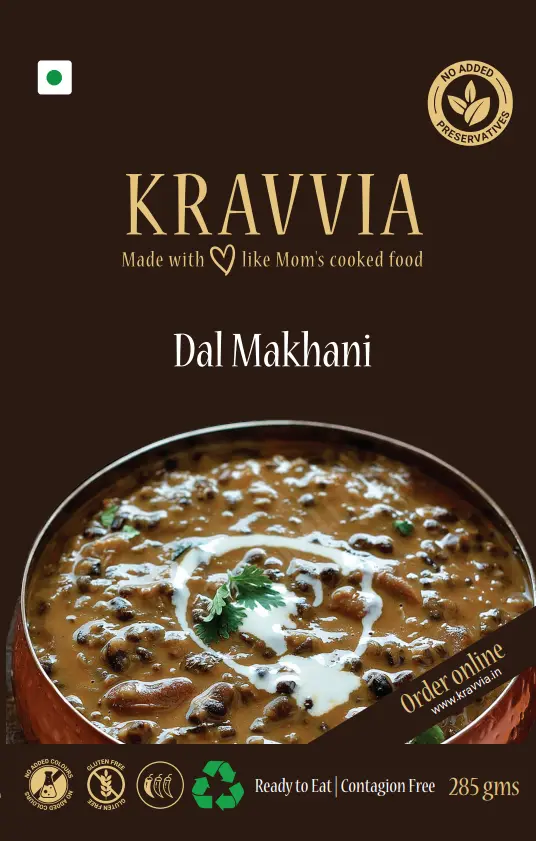
121°C. 365 days. The same dal makhani.
Twelve months. Room temperature. No preservatives. Those are the three non-negotiable constraints on every SKU in the Kravvia ready-to-eat line. For most recipes they are engineering challenges. For dal makhani (a dish whose identity is built on time, fat, and the slow marriage of whole urad dal with butter and cream) they are a direct confrontation with the recipe itself.
The catering version of Kravvia's dal makhani is built the way it has always been built since Priti S Shah founded the kitchen in Santacruz in 1999: whole urad dal soaked overnight, simmered on a low flame for six-plus hours, finished with a knob of butter and a ribbon of cream at the very end. The wedding kitchen build. It is the version guests encounter at corporate lunches in BKC and receptions in Juhu.
The retort pouch version has to survive sterilisation at 121°C and above, sealed inside a multi-layer barrier pouch, at room temperature for 365 days, and then reheat in four minutes and taste like something deliberate. Here is, specifically, what the translation requires.
The Base Recipe: What Goes Into the Pouch
The ingredient list on every Kravvia dal makhani pack is visible, complete, and unabbreviated. It contains eight components:
- Whole urad dal: the foundation. Not split, not dehusked. Whole. The black skin carries the colour and the body.
- Tomato: cooked into a deep paste, not added fresh. The reduction does structural work: it concentrates the acidity and builds the mahogany base that reads as slow cooking.
- Onion: sweated long before the dal enters. Caramelisation here is load-bearing, not optional.
- Cream: added in two stages in catering prep. In the retort version, the timing of the second addition is adjusted, as explained below.
- Butter: likewise fat-ratio adjusted for the retort build.
- Ginger-garlic: freshly prepared paste, not powdered.
- Kasuri methi: dried fenugreek leaf. In catering prep it goes in at the finish. In the retort build, the timing is critical.
- Indian spices: the whole-spice and ground-spice blend that gives the dal its depth and warmth without sharpness.
Nothing on that list is a preservative. Nothing is a stabiliser or a thickener added for process reasons. The shelf stability comes entirely from the sterilisation process and the pouch, not from the formula.
What Sterilisation Does to the Recipe
Retort sterilisation is not boiling. The sealed pouches are loaded into a pressurised retort vessel and raised to 121°C or above at controlled pressure for a defined cycle duration. The target is a commercially sterile product: specifically, the elimination of Clostridium botulinum spores, which is the regulatory and safety benchmark for ambient-stable food. This is expressed as an F0 value: the cumulative lethal effect of the heat cycle at a reference temperature of 121.1°C.
At 121°C, the Maillard reaction, the same browning chemistry responsible for the roasted depth in slow-cooked dal, runs hard and fast. In catering prep that depth builds over six hours at a comparatively low flame. In the retort cycle it is happening in minutes at a temperature the stovetop never reaches. Left unmanaged, this produces a flatter, more uniform brown note with less aromatic complexity: the difference between slow-caramelised and scorched.
Several flavour-active compounds break down under the heat load. Volatile aromatic compounds in the ginger-garlic (which carry the fresh, pungent top note) are among the most heat-labile. Kasuri methi's characteristic bitter, grassy note, which reads as freshness in the finished catering dish, also degrades significantly at retort temperatures. Cream proteins denature and the fat emulsification shifts. The butter's dairy solids undergo their own browning. Every one of these changes has to be anticipated and compensated for in the pre-retort recipe build, not corrected afterwards.
How Kravvia Counters Each Problem
Pre-cook reduction and the tomato paste
In the retort build, the tomato is cooked down further than in the catering version (to a denser, drier paste) before the dal is added. This is deliberate: the retort cycle will continue to concentrate and reduce whatever liquid is in the pouch, and if the tomato hasn't been pre-reduced sufficiently, the finished product arrives over-concentrated and acidic. The pre-reduction also gives the Maillard chemistry in the retort cycle something to deepen rather than char.
Fat ratio adjustment
The butter-to-cream ratio in the retort build is adjusted from the catering proportion. Butter is a more stable emulsifier under high-heat sterilisation than cream; cream's water content creates more steam pressure in the sealed pouch and its proteins are more susceptible to denaturation at 121°C. The retort build shifts the fat balance toward butter early, with a controlled quantity of cream added at a stage that allows it to homogenise into the dal base rather than sitting as a separate ribbon, the way it is added at finish in catering prep.
Kasuri methi at packing, not at cook
This is the single most consequential timing change in the entire retort translation. In catering prep, kasuri methi is crushed between the palms and added in the final two minutes over heat. Its volatile oils release into the hot dal and the dish is served immediately. At retort temperatures, those same volatile oils are destroyed in the sterilisation cycle if the methi is added early in the cook.
In the retort build, the kasuri methi is added at the point of filling: after the base is fully cooked and immediately before the pouch is sealed. It is present in the pouch during sterilisation, which means it undergoes some thermal degradation, but the quantity is calibrated so that what survives the cycle is sufficient to deliver the characteristic fenugreek note at serving. This is an adjustment the catering recipe does not need to make; it is entirely a function of the retort process.
The Pouch Chemistry: What Keeps 12 Months Out
The pouch that protects the dal makhani for 12 months at ambient temperature is a multi-layer laminate. Each layer serves a distinct function in the barrier system.
The outer layer is a biaxially oriented polyester film: dimensionally stable under the mechanical stress of the retort cycle and resistant to abrasion in transit. The middle layer is an aluminium foil laminate: the primary barrier against oxygen, moisture vapour, and light, all three of which drive spoilage and oxidative degradation in the absence of preservatives. Without an intact aluminium layer, the 12-month shelf life is not achievable, regardless of how thoroughly the product is sterilised. The inner layer is a food-contact polyolefin: a heat-sealable film that forms the seam holding the pouch closed, compatible with the hot-fill and retort temperature range, and inert against the acidic tomato and fat content of the dal.
The integrity of the seal is as important as the integrity of the layers. A micro-breach in the heat seal, invisible to the eye, is sufficient to allow oxygen ingress that will spoil the product within weeks. Every sealed pouch is tested for seal integrity before it leaves the production line; a pack that fails the test is discarded. The ingredient list, FSSAI licence number, MFG date, and EXP date on the back panel are your readable record of that provenance.
The 4-Minute Reheat: Pan vs Microwave
The heating protocol printed on every Kravvia dal makhani pouch is specific, not approximate.
Pan method: Tear the pouch and pour the contents into a pan. Simmer on a medium-low flame for four minutes, stirring occasionally. This is the preferred method. The direct-heat application loosens the dal to its correct consistency, allows a small amount of reduction to concentrate the base, and gives the kasuri methi a second activation: the residual volatile oils that survived sterilisation release into the hot fat. The result is closer to the catering plate.
Microwave method: Transfer to a microwave-safe bowl. High power for 90 seconds. This is faster and adequate, but the heating is less even: the edges of the bowl heat before the centre, and the dal doesn't get the same reduction the pan provides. Stir once at the 45-second mark if your microwave doesn't rotate. Don't reheat in the sealed pouch; the aluminium layer is not microwave-safe.
Both methods assume correct storage: room temperature, away from direct sunlight. Prolonged heat or light does not accelerate spoilage immediately, but degrades the aluminium barrier over months and can shift the internal pressure of the sealed pack. The storage instruction applies to the full 12-month window, not just the final week.
The Taste Comparison: Catering vs Retort
An honest accounting: they are not the same, and they are not trying to be.
The catering dal makhani (built fresh, finished minutes before it reaches the chafing dish at a Powai wedding) has a creamier, less concentrated top note. The kasuri methi is sharper. The butter sits on the surface as a separate, visible layer. The texture of the urad dal is fractionally more yielding because it has not been through a pressurised heat cycle.
The retort dal makhani is denser. The base is more integrated: six hours of slow cooking compressed and then deepened by the retort cycle produces a dal where the tomato, spice, and dal have become a single, thick, nearly indistinguishable mass. The kasuri methi note is present but quieter. The fat is fully emulsified into the base. Some guests prefer this version. It has more weight.
What the retort version does not do: it does not taste preserved. It does not taste of tinned food. It does not taste like a shortcut. The ingredient list is the same eight components. There are no preservatives to taste because there are none added. What you are tasting is the same recipe run through a different process, with each adjustment (pre-cook reduction, fat ratio, kasuri methi timing, pouch specification) made because the catering recipe, without modification, does not survive sterilisation with its character intact.
Who This Is For
₹190 per pouch. Serves one to two. Ships pan-India without a cold chain: a Mumbai expat in Bangalore, a corporate gifting manager building Diwali boxes, a host in Powai who wants Kravvia's catering dal in the pantry without a catering booking. The 12-month shelf life means festive-box orders can be built to stock (Diwali, Rakhi, corporate year-end) without the timing pressure of fresh production.
Pair it with Jeera Rice from the same retort line, or with hot tandoori roti. The Jain variant (no onion, no garlic, no root vegetables) is separately available at the same price point and carries the same 12-month guarantee.
WhatsApp Priti at +91 98207 11758 for festive box quotes or pan-India shipping.
She replies herself, often within the hour.
Peace · Purpose · Progress