Women-Led Catering in Mumbai: The Labour Economics of Building a Culinary House from 1999
In 1999 Santacruz, Priti S Shah entered a wedding-catering market structured entirely around male-run operations. Here is what changed, and what compounded.
Santacruz, 1999: A Kitchen Without a Template
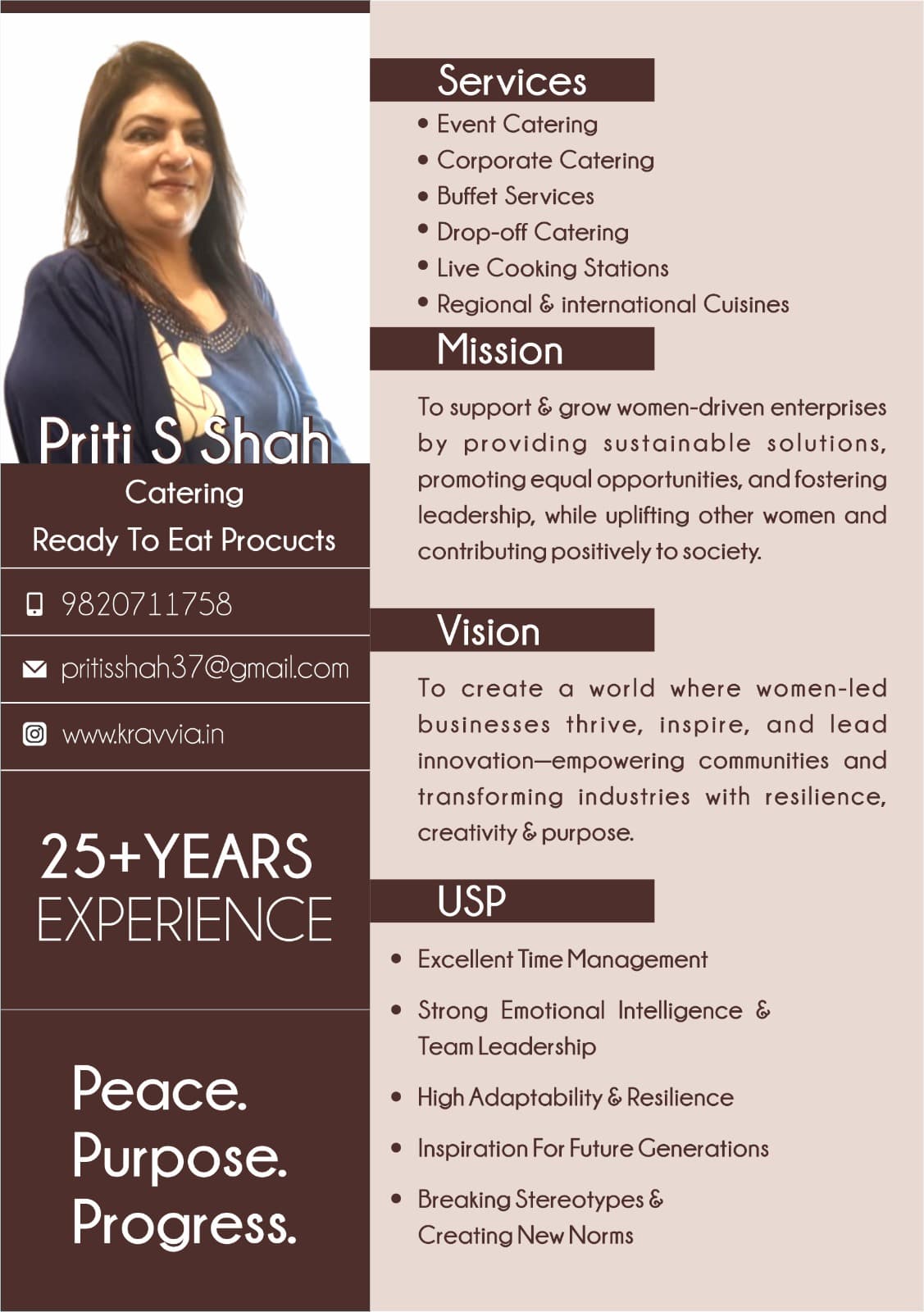
In 1999, the wedding-catering market in Mumbai ran almost entirely on a single organisational model: a male proprietor, a predominantly male kitchen brigade, and client acquisition through male-dominated social networks: family associations, community trusts, banquet hall referrals. Priti S Shah started Kravvia in Santacruz that year with a kitchen of two, no investors, and no precedent for what a women-led culinary house in this market would look like structurally. The absence of a template was not incidental. It shaped every hiring, sourcing, and client-facing decision that followed.
This is not an account of obstacles overcome. It is an account of market structure: what the catering trade in Mumbai looked like in 1999, what specific operational decisions a women-led entry into that market required, and what twenty-five years of consistent execution has compounded into.
The Labour Market a Women-Led Business Entered
Wedding catering in 1990s Mumbai was a piece-rate economy. Male cooks were hired event by event, often through informal labour networks centred on particular neighbourhoods (Dharavi, Malad, Goregaon) where kitchen labour congregated. A caterer's reliability was partly a function of how embedded the proprietor was in those networks. A new entrant without existing ties to those labour channels faced a structural disadvantage that was not about gender in any abstract sense, but about the physical geography of how casual kitchen workers were sourced and retained in that era.
Priti's response, expressed consistently across the early years of Kravvia's operation, was to build inward rather than outward. Instead of competing for transient piece-rate labour, Kravvia developed a smaller, trained, and retained core team. The immediate cost was higher labour expense per event. The compounding benefit, visible only over years, was consistency: the same mise en place logic, the same spice-grinding cycle, the same plating standard across events.
In a market where event-to-event quality variation was accepted as normal, consistency itself became a differentiator. Corporate clients (who began arriving after the 2006 inflection point, when Kravvia took on daily 200-cover lunches for a BKC office) specifically cited predictability as the reason for repeat engagement. The labour model that looked like a cost disadvantage in 1999 was, by 2006, a sales argument.
Client-Facing Decisions: Who Signs the Contract
The wedding-catering sales cycle in Mumbai runs through the family making the event, typically the senior male members, who hold the vendor relationship. In 1999, a proprietor presenting herself directly to this decision-making unit was unusual enough to require explanation. Priti's approach was to meet that dynamic with precision rather than deference. The enquiry call was answered with specifics: per-head cost bands, cuisine options, dietary-spec capability, Jain kitchen status. The conversation became technical before it became relational.
This had a secondary structural effect. Word-of-mouth referrals in the catering trade tend to travel through the social network of whoever managed the vendor relationship. When Priti ran the client-facing function directly, referrals travelled through women in those family networks: mothers, aunts, sisters-in-law who had observed the event and formed their own assessment of quality. That referral channel proved durable. It also skewed Kravvia's client base toward repeat multi-event relationships rather than one-off bookings, because the women making the referrals were often the same people involved in subsequent family events.
Sourcing: Where a Women-Led Operation Changed the Vendor Relationship
Produce sourcing for a Mumbai catering kitchen in the early 2000s meant early-morning runs to wholesale markets (Crawford Market, APMC Vashi) where the negotiation culture was entirely male. Priti's decision was to move sourcing upstream as quickly as volume permitted: direct relationships with Nasik vegetable farms, a fixed Khar supplier for paneer, a controlled spice-grinding cycle run in-house rather than through third-party masala vendors.
The practical motivation was quality control. A caterer who buys produce in the wholesale spot market on the morning of an event has limited leverage over what arrives. A caterer with a standing relationship with a Nasik farm knows three days in advance what the tomato yield looks like and can adjust the menu accordingly. The sourcing decisions that looked like operational preference were also risk management, and risk management that required no external validation to implement.
By 2012, when the Jain kitchen was built (a fully isolated second prep space, not a token adjustment to the main kitchen), the sourcing infrastructure to support it was already in place. Root vegetables, alliums, and cross-contamination risks were managed through procurement protocols, not kitchen improvisation. The Jain promise Kravvia makes today is enforced at the vendor level, not just the cooking level.
The 2006 Corporate Turn: When Scale Tested the Model
Daily 200-cover corporate lunches for a BKC office represented a different operational problem than wedding catering. Weddings have long lead times, defined menus, and clear service windows. A daily corporate contract runs five days a week, with rotating menus, no tolerance for repetition, and procurement cycles that have to sync with a Mumbai traffic pattern that does not co-operate with late deliveries.
Scaling into this without degrading quality required two things the early Kravvia model had already built: a retained core team that could execute a consistent standard without per-event retraining, and a sourcing relationship that was stable enough to deliver predictable ingredient quality across a rolling weekly menu. Both had been built, at higher upfront cost, precisely because the piece-rate model was not available to Kravvia in the same way it was available to established male-run operations.
The 2006 corporate contract also introduced Kravvia to the dietary-specification culture of the modern Mumbai workplace (gluten-free, sugar-free, nut-free, no-onion-garlic), which would later become a formal capability documented in a single brief distributed to every event team. The operation that could run a Jain-isolated prep room in 2012 was the same operation that had been managing dietary specs for corporate clients since 2006.
Cuisine Expansion and the Staffing Logic Behind It
In 2018, Italian, Thai, and Mexican entered the Kravvia canon, bringing the total to eight cuisines. The staffing logic was specific: each cuisine addition was anchored by a trained specialist, not distributed across the existing brigade. This is an expensive model. It is also the only model that produces consistent results when a wedding guest at a live pasta counter at a Juhu reception expects the same result as a guest at the same counter in Worli three months later.
The decision to staff for quality before scaling for volume is one that runs counter to the margin logic of most catering operations, where labour cost is the primary variable expense and generalist kitchen staff are preferred for their flexibility. Kravvia's structure has always run in the opposite direction: specialists retained, volume scaled within their capacity, not beyond it. This is a women-led operation's structural preference expressed as kitchen economics: control over outcome, even at the cost of top-line scale.
The 2022 Retort Line: What 23 Years of Kitchen Discipline Produced
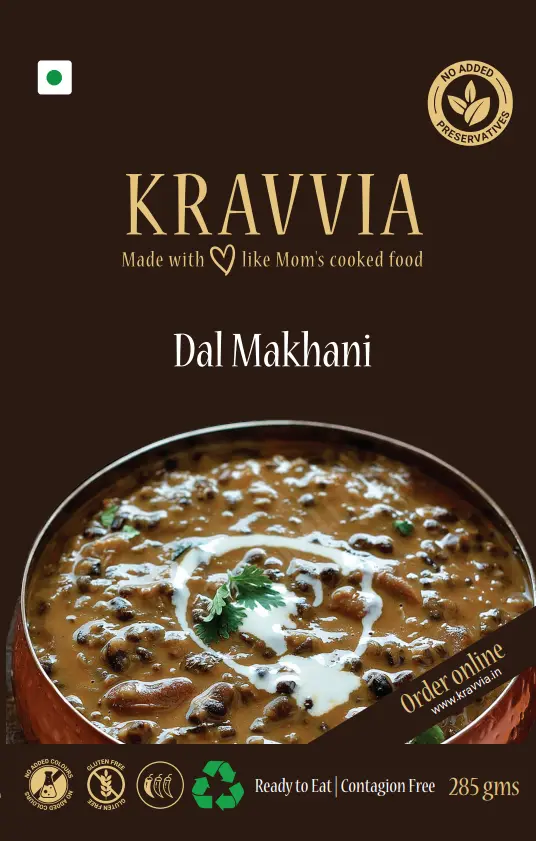
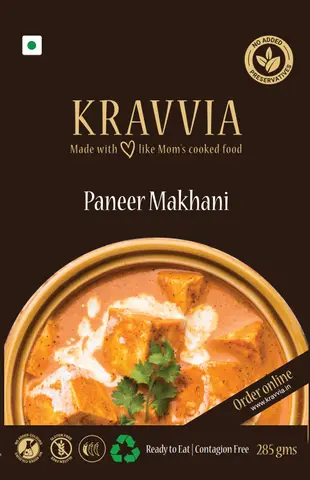
The retort production line (13 SKUs, 12-month shelf life, zero preservatives) launched in 2022. It is not a diversification from the catering business. It is a direct expression of the same kitchen discipline applied to a different distribution channel. The no-preservatives constraint that Priti imposed on Kravvia's catering from the first event in 1999 required, in the retort context, a set of food-engineering decisions around sterilisation cycles, pouch chemistry, and moisture management that most vegetarian retort producers resolve by adding preservatives instead.
The retort line ships pan-India. Its quality benchmark is Kravvia's catering, which means the same sourcing relationships, the same spice-grinding cycle, the same standard that runs a 600-guest wedding reception in Bandra also runs a retort pouch of dal makhani that reaches a customer in Powai or Lower Parel or a city outside Maharashtra entirely.
What 25 Years Compounds
In 2026, Kravvia operates eight cuisines, a dual-kitchen Jain build, nine live counters, and 13 retort SKUs produced to one specification. The team that runs it is the institutional product of a hiring model that prioritised retention over transience, a sourcing model that prioritised upstream relationships over spot procurement, and a client-facing model that prioritised technical specificity over social deference.
None of these decisions were made because they were the easiest path. They were made because, in 1999 Santacruz, the easiest path (the piece-rate labour network, the wholesale spot market, the male-referral sales chain) was either unavailable or structurally unsuitable for what Priti S Shah was building. The constraints of entering a male-dominated market as a women-led operation in 1999 produced an operational discipline that, compounded over twenty-five years, is now Kravvia's primary competitive asset.
For event hosts in Andheri, Bandra, Juhu, Powai, BKC, Lower Parel, Worli, Vile Parle, Santacruz, Khar, and South Bombay planning weddings, corporate events, or festive occasions in the next six to twelve months: the operational infrastructure described above (stable sourcing, retained specialists, documented dietary-spec protocols, Jain-isolated prep) is available at per-head rates starting from ₹650. The retort line ships to any delivery address.
WhatsApp Priti at +91 98207 11758 to book a tasting.
She replies herself, often within the hour.
Peace · Purpose · Progress