2022: The Engineering Behind Kravvia's Zero-Preservative Retort Line
Thirteen SKUs, 12-month shelf life, zero preservatives. The food-engineering decisions Priti S Shah made to build a vegetarian retort that doesn't taste like one.
2022: A Format Decision, Not a Philosophy Shift
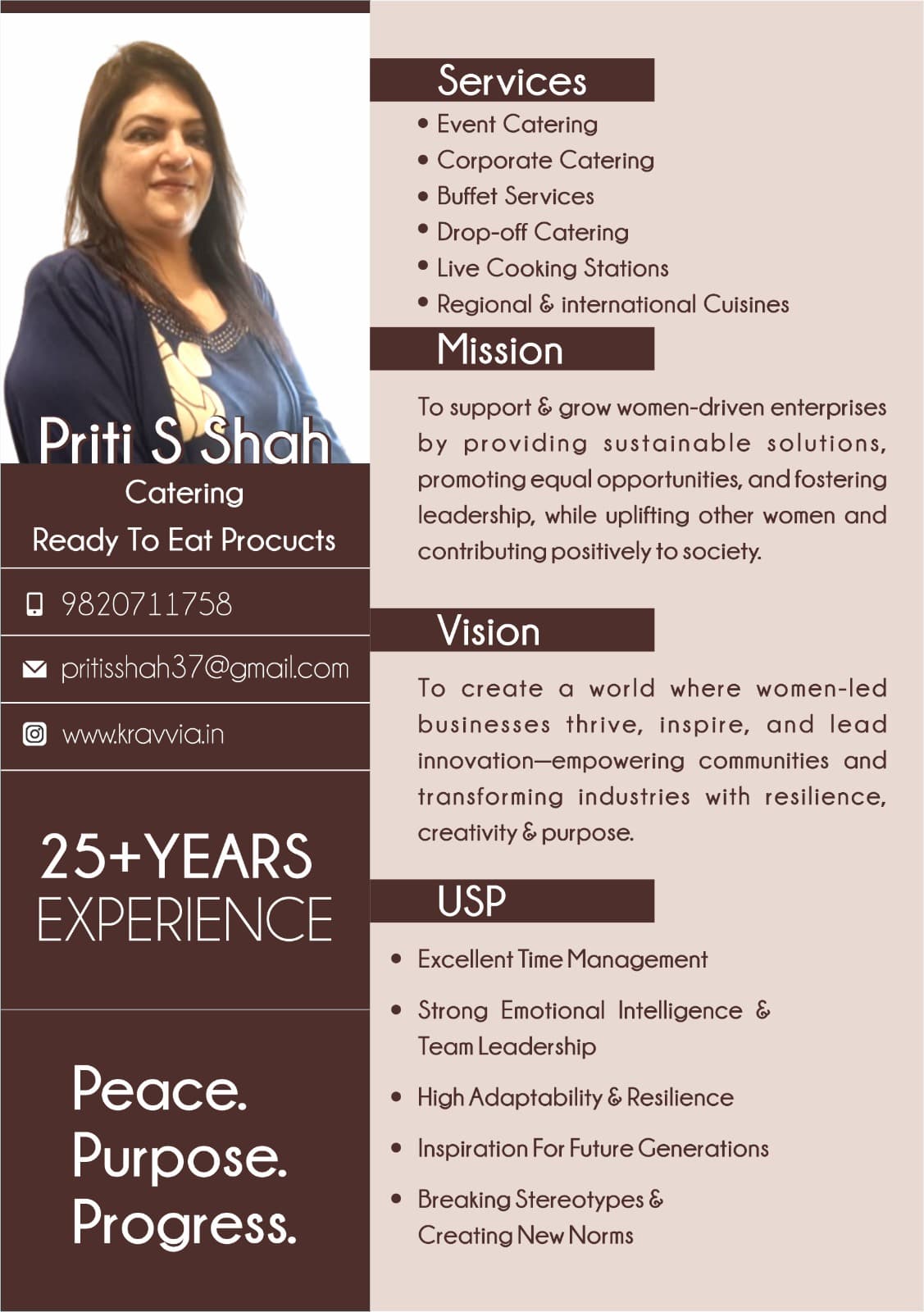
In 2022, twenty-three years after she started catering family weddings out of a Santacruz flat, Priti S Shah committed to a retort production line. Thirteen SKUs. A 12-month shelf life at room temperature. No preservatives, no additives, no exceptions. The announcement read like a product launch. It was, in practice, an engineering project: one that took the better part of two years of recipe reformulation, process testing, and cycle calibration before the first pouch left the line.
The retort format was new. The philosophy was not. Kravvia had been built on a single constraint since 1999: no preservatives, at any scale. What changed in 2022 was the mechanism: moving from cook-and-serve to retort sterilisation. The challenge was proving that the constraint could survive the mechanism.
What Retort Sterilisation Actually Does to Vegetarian Food
Retort sterilisation is a controlled application of heat and pressure, typically in the range of 121°C for a defined duration, sufficient to achieve commercial sterility inside a sealed multi-layer pouch. The metric that governs the process is the F0 value: the equivalent number of minutes at 121°C required to reduce the target microbial load to a safe level. An F0 value of 3 to 6 is the working range for most ready-to-eat applications; the exact target depends on the product's pH, water activity, and particulate density.
For meat-based retort products, the fat content and protein structure act as buffers; they absorb some of the thermal load and hold texture reasonably well through the sterilisation cycle. For vegetarian products, there is no such buffer. Paneer softens, then collapses. Dal skins split. Spice compounds oxidise. The volatiles that carry aroma (the kasuri methi top-note, the cumin bloom, the cream's fresh lactic edge) escape in the first minutes of sustained high heat. A vegetarian retort that is simply a catering recipe sealed in a pouch will taste exactly like what it is: something cooked twice, once for the dish and once for the steriliser.
Priti's starting question, as Kravvia's product team approached the retort line in 2022, was not how to package existing recipes. It was how to reformulate them so the version that emerges from a 12-month shelf at room temperature is indistinguishable from a fresh kitchen plate.
The Multi-Layer Pouch: Chemistry Before Content
The choice of pouch structure precedes any recipe decision. Retort pouches are laminated composites: typically a three- or four-layer structure combining a heat-resistant outer layer (commonly biaxially oriented polyester or nylon), a metallic or high-barrier middle layer for oxygen and light exclusion, and a food-contact inner layer (polypropylene). Each layer serves a specific function: structural integrity at processing temperatures; oxygen barrier to prevent lipid oxidation; and a sealable, non-reactive surface that will not leach compounds into the food at 121°C.
For a zero-preservative product, the pouch chemistry is not secondary. It is the first line of defence. Without antioxidants or antimicrobials in the formulation, the barrier properties of the laminate must be effectively absolute. Any oxygen ingress after sealing will oxidise the fats in cream, butter, and ghee, and degrade the spice pigments. The result is a product that smells stale by month four. Kravvia's specification work on pouch selection in 2022 focused on achieving oxygen transmission rates low enough to hold colour and aroma integrity across the full 12-month window, not just to pass the required safety tests.
Reformulating the Recipes: Spice Ratios and Cooking Sequence
The practical engineering work began when existing catering formulas met the sterilisation process in a test environment. The findings were consistent and unsurprising to anyone who had done this work before: the dishes that came out of the retort tasted flat, muted, and slightly overcooked, even when the F0 value was within the target range.
Three categories of change were needed.
Spice Ratio Adjustment
Volatile spice compounds (the aromatic fractions that carry warmth, lift, and freshness) degrade at retort temperatures. A recipe calibrated for a 25-minute catering cook will lose a disproportionate amount of its spice character in a retort cycle, even if the total cook time is shorter, because the temperature is significantly higher. The correction is to increase the loading of certain spice components before processing, with the expectation that post-sterilisation levels will land at the intended finish. This is not a straightforward scalar increase: different compounds degrade at different rates. The kasuri methi bitterness, for instance, survived the cycle better than its aroma did; over-correcting for aroma loss produced a product with an overly sharp fenugreek edge. Each SKU required its own calibration.
Cooking Sequence Reversal
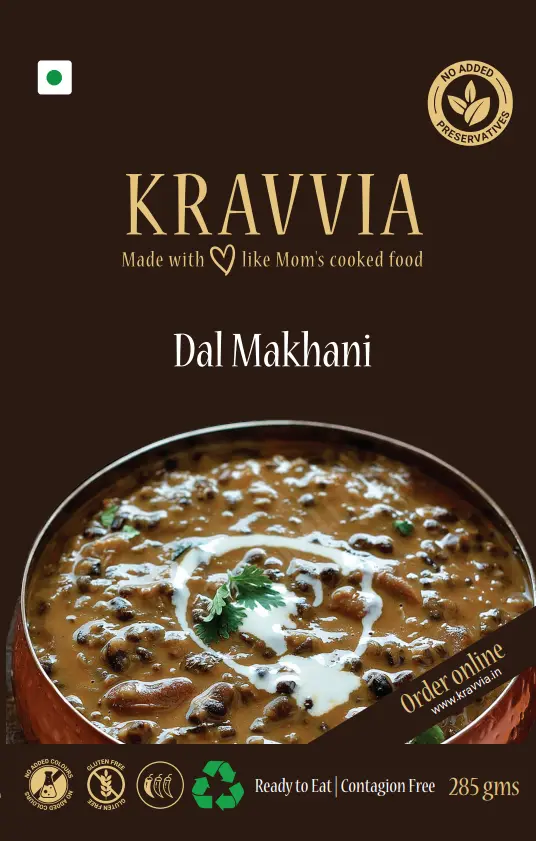
In a catering kitchen, certain ingredients are added late in the cook because they are delicate: fresh cream, butter, kasuri methi crushed in at the end. In a retort process, late-addition logic inverts. Ingredients that will see the full thermal load must be pre-adapted to survive it. For the Dal Makhani, the original six-hour slow-simmer that is Kravvia's catering anchor, the retort version required pre-cooking the dal to a specific hydration and starch release point before sealing, so that the sterilisation cycle's additional thermal energy moved the texture to the right place rather than past it. The cream and butter are present in the formulation but in ratios calibrated to hold their emulsion through processing; a finishing knob added post-heat gives the fresh-kitchen illusion when the consumer warms the pouch.
Particulate Geometry
Heat penetration in a sealed pouch is a function of convection through the product mass. A dense, viscous product (thick dal, heavy cashew-based gravy) heats more slowly at its centre than a thinner one. This means a dense product requires either a longer sterilisation time (which increases total thermal load and flavour damage) or a lower product fill depth and geometry adjustment (which maintains adequate heat penetration at a shorter cycle). The Paneer Makhani's cashew-tomato gravy, dense by design, was reformulated to a slightly lower viscosity in-pouch, enough to allow adequate heat penetration without reducing F0 compliance, knowing that the consumer's four-minute pan warm restores the body the thicker gravy would have provided fresh.
The Jain SKUs: A Double Constraint
Six of Kravvia's 13 retort SKUs are Jain-spec: no onion, no garlic, no root vegetables at any stage of production or processing. The Jain formulations had been tested across two decades of Jain wedding catering (the Jain Dal Makhani, the Jain Paneer Makhani, the Jain Amritsari Chana, the Jain Malai Methi Matar among them), but adapting them for retort introduced a specific problem: the body and depth that onion provides in a conventional formulation had already been replaced by slow-roasted tomato and cashew paste. In the retort process, cashew paste behaves differently under heat than onion-based gravies do. The starch in cashew gelatinises at retort temperatures, which can produce a gummy texture if the ratio is not adjusted downward from the catering formulation. Finding the cashew-to-tomato ratio that held flavour at month 11 without textural penalty required more development cycles on the Jain SKUs than on the conventional ones.
Month 11: The Test That Mattered
Commercial shelf-life validation for a 12-month claim requires accelerated stability testing: samples held at elevated temperature and humidity for a defined period, then assessed against organoleptic and microbiological criteria. But Priti's test was different: she tasted the product at month 11. Not against a specification sheet. Against memory: what the dish was supposed to taste like as it came off the catering line. The formulations that passed were the ones that could not be distinguished, in a warm bowl, from a freshly cooked plate. The ones that failed went back for another reformulation cycle.
This is the distinction between retort as a preservation technique and retort as a format decision. The sterilisation cycle can be engineered to any F0 target. The flavour outcome at month 11 is a function of recipe architecture, and that part cannot be delegated to a food technologist with a calculator. It requires someone who knows what the dish is supposed to taste like, and who is unwilling to sign off on a version that doesn't.
What This Means for the Buyer
The 13 SKUs, priced in the ₹160–200 band, ship pan-India at room temperature without cold chain. They are, in format, a shelf-stable product. In content, they are the catering formulas that Kravvia has been refining since 1999, adapted to survive a sterilisation cycle and emerge from a four-minute warm as they were intended to be eaten. The 12-month shelf life is not a concession to convenience; it is the result of choosing a format that can hold a standard, then engineering the recipe to meet it.
For hosts planning festive gifting (Diwali boxes, corporate hampers, pan-India family shipments), the retort line removes the cold-chain constraint without compromising Kravvia's no-preservative position. The format changed in 2022. The rule did not.
WhatsApp Priti at +91 98207 11758 for festive box quotes or pan-India shipping.
She replies herself, often within the hour.
Peace · Purpose · Progress