The Jain Promise: Why Kravvia Built a Second Kitchen in 2012
In 2012, Kravvia erected a fully isolated Jain prep area: separate utensils, separate spice grinder, no root vegetables, no compromise.
2012: A wall goes up
In 2012, Priti S Shah made a capital decision that most caterers in Mumbai never make. She partitioned the kitchen. One side for the standard run: Punjabi, Gujarati, Maharashtrian, Chinese, the broad vegetarian canon that had kept the house busy since 1999. The other side for Jain prep only. Separate utensils, separate spice grinder, separate section of the cold store, dedicated cook briefed exclusively on Jain specifications. No shared surfaces during service. No shared anything.
The trigger was a pattern she kept seeing at other caterers' events: a spread labelled Jain that was, in practice, the standard spread with the obvious offenders pulled out. Onion and garlic absent from the finished dish, present in the pan that cooked the previous batch. Root vegetables gone from the menu card, but the chopping board still carrying traces of potato and carrot from the prep that ran an hour before. The Jain guests at these events ate the food. They had no way to verify the kitchen. And the caterers had no particular reason to change.
Priti's view, formed across thirteen years of Jain wedding and corporate catering by 2012, was that this arrangement failed the people it was supposed to serve. Not catastrophically: nothing would go wrong in any obvious sense. But a genuine Jain kitchen is not a menu edit. It is a physical separation of prep, utensils and workflow. Without that separation, the label is aspirational at best.
What a real Jain kitchen actually excludes
The public understanding of Jain dietary requirements tends to stop at onion and garlic. That gets the headline right and misses most of the work.
The full exclusion list for strict Jain cooking covers all root and underground vegetables: onion, garlic, potato, carrot, beetroot, radish, turnip. The rationale is Jain ahimsa: root harvesting destroys the entire plant and any organisms living in the soil around it. The prohibition is not about flavour; it is about the conditions under which the ingredient was obtained.
Beyond vegetables: no fermented ingredients. No vinegar. No certain pickles. Some Jain specifications exclude ginger as well, since it is technically a rhizome (underground stem), though practice varies across communities and Kravvia checks the specific community standard at each booking.
For the kitchen team, the exclusions create a different flavour architecture problem. Dal makhani, paneer makhani, navratan korma, chana masala: these are dishes whose standard builds are grounded in an onion-garlic base that provides sweetness, body and the long, dark colour of a properly cooked masala. Remove that base and you need to reconstruct the flavour from what remains: tomato cooked long enough to concentrate and caramelise, cashew paste for body, ginger where the spec allows it, and a spice blend calibrated to work without the allium scaffolding.
This is not a small adjustment. The spice grinding changes. The sequence of the cook changes. The time required changes. A Jain dal makhani cooked correctly is not a standard dal makhani with an ingredient left out. It is a dish that reaches the same depth via a different route. That route requires its own grinder (spice residue from a shared grinder carries trace allium compounds), its own utensils, and a cook who knows the technique, not just the exclusion list.
The 2012 kitchen layout
The decision in 2012 was therefore not about labelling. It was about workflow. The Jain prep area was isolated at the level of physical infrastructure: dedicated prep counter, dedicated knife set and chopping boards, dedicated cooking pans, dedicated spice grinder, a separate shelf in the cold store for Jain-sourced ingredients. No ingredient that had been in contact with onion, garlic or root vegetables entered the Jain prep area.
This mattered practically in two directions. First, for the events: Jain wedding families and corporate clients booking board lunches at BKC could be told, accurately, that their food had not shared prep space with the standard menu. Second, for the kitchen: the separation forced a discipline that sharpened the Jain recipes. When your Jain cook cannot reach for the standard spice base as a shortcut, they learn the Jain build properly. After enough repetitions, the Jain dal makhani is as calibrated as its standard counterpart: different architecture, equivalent result.
The Jain catering menu that Kravvia runs today reflects fourteen years of that discipline. Jain starters: Hara Bhara Kabab built without potato, Corn Tikki reformulated without the standard potato binder, Rajma Kabab clean to spec. Jain main course: Dal Makhani, Paneer Makhani, Navratan Korma with seasonal vegetables replacing the root-vegetable bulk, Dal Fry and Dal Tadka both recalibrated. Jeera rice, Veg Pulao. Desserts: Moong Dal Halwa and Gulab Jamun are clean to spec. Every dish has been cooked at scale, at enough Jain weddings and corporate events across Andheri, Bandra, BKC, Powai, Juhu and Lower Parel to have been stress-tested.
What fourteen years compounded into
By 2022, when the retort production line launched, there were four Jain SKUs in the initial lineup, not as an afterthought, but as a direct extraction from the Jain catering menu that had been in active service since 2012.
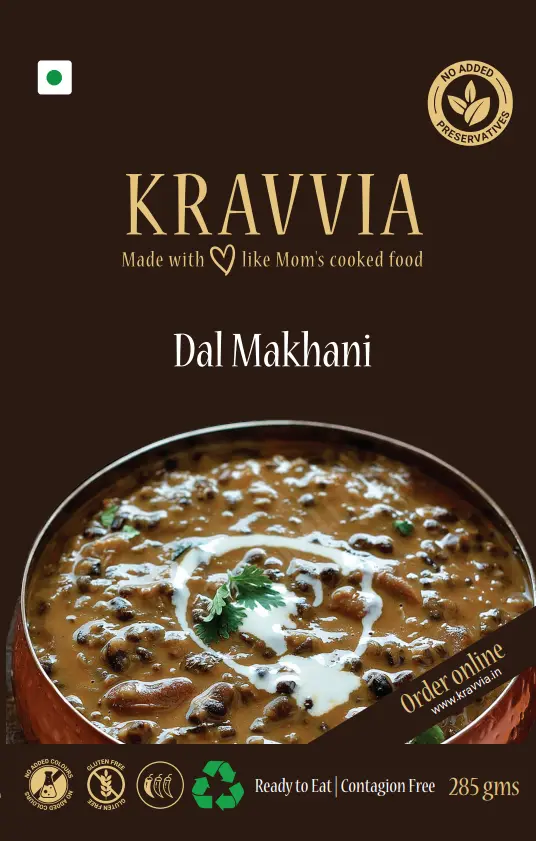
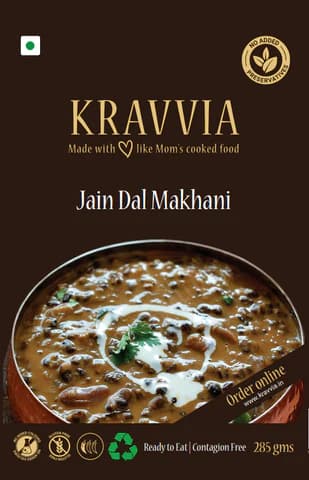
The Jain Dal Makhani at ₹190 is the catering-menu dal makhani in retort form. Whole urad dal, overnight soak, six-plus hours slow-simmer. No onion, no garlic, no root vegetables. Tomato cooked down to a deep paste; cashew for body in place of the allium base; butter and cream for the finish. The spice blend is the one tested across a decade of Jain wedding kitchens. Four minutes in a pan.
The Jain Paneer Makhani at ₹190 applies the same reconstruction logic to the makhani gravy: slow-roasted tomato and cashew paste for body, butter and cream for richness, kasuri methi for the finish. No onion, no garlic at any stage of the build. The gravy reaches the same depth and colour as its standard counterpart; the absences do not read on the palate.
The Jain Amritsari Chana at ₹160 is the most instructive of the four. The character of Amritsari chana (the dark masala, the tea-leaf colour, the anardana tartness) lives in the spice architecture, not in the onion. The standard version uses onion for sweetness and body; the Jain version compensates with more tomato and a slightly adjusted spice ratio. What you lose is marginal. The anardana tang, the tea colour, the weight of whole Kabuli chana: all present.
The Jain Malai Methi Matar at ₹190 illustrates a technique decision specific to Jain cooking. Methi, fenugreek leaves, is bitter if handled incorrectly. The Kravvia build blanches the methi first, cutting the bitterness while keeping the herbal depth. Cashew-cream gravy; green peas for sweetness; tomato to balance. No onion, no garlic, no roots. A staple on the Jain catering menu for twenty years before it became a retort SKU.
All four SKUs carry the same 12-month shelf life and zero-preservatives specification as the rest of the retort line. They are produced in the Jain prep area, not on the standard line. The isolation that started as a kitchen wall in 2012 runs through to the retort production workflow in 2026.
The BKC corporate read
The practical application of the 2012 decision shows most clearly in the BKC corporate lunch market. Kravvia's order data puts Jain specifications on 30–40% of all corporate lunch briefs from Bandra-Kurla Complex: finance houses, law firms, consulting offices at One BKC, Platina and C-70. A 40-person board lunch at a BKC law firm that specifies Jain is a logistics event. Someone at that table is senior. The food will be noted if it is wrong.
A caterer who says Jain available and delivers standard prep with onion and garlic removed from the visible dish has not met that spec. The Jain guests at the table will know, not from any single identifiable factor, but from the cumulative texture of the gravy, the spice balance, the depth of the dal. Food cooked with the full allium base tastes different from food cooked without it. A cook who knows the Jain build produces a result that stands on its own. A cook who just omits produces a result that reads as diminished.
For BKC corporate events, Kravvia deploys Jain live counters where the brief calls for it: chaat skipping raw onion and potato papdi, the Asian Wok station briefed without spring onion, pizza with Jain toppings. Each station cook is briefed on cross-contamination protocol. The operational discipline built into the kitchen layout in 2012 scales to the event floor in 2026.
How to spec a real Jain caterer
If you are booking Jain catering for a Mumbai event (a 200-guest Jain wedding reception in Juhu, a 60-person board lunch at Worli, a festive corporate spread at Powai), a short checklist separates genuine Jain preparation from a menu edit.
- Ask about the prep area. Is there a dedicated Jain prep station, or does Jain food share prep space with the standard menu? A shared prep counter is not a Jain kitchen, regardless of what the menu says.
- Ask about the spice grinder. A shared grinder carries trace allium compounds in the residue. A caterer with genuine Jain infrastructure has a dedicated grinder for Jain spice blends.
- Ask about the utensils. Dedicated Jain utensils, labelled and stored separately, not borrowed from the standard kitchen during service.
- Ask about the cook. Who is running the Jain station? How long have they been cooking Jain spec? A cook trained on the Jain build has a different technique from a cook told to omit onion and garlic from their standard approach.
- Ask about ginger. Ginger is technically a rhizome. Some Jain communities exclude it; others accept it. A caterer who knows Jain cooking will ask which specification you need; one who does not will look confused.
- Ask about the retort options. If you need Jain-spec ready-to-eat food for corporate gifting or retail (pan-India shipping, 12-month shelf life), the four Jain SKUs from Kravvia are the relevant offer.
The Jain catering market in Mumbai is large enough to have produced a full range of quality levels, from careful to careless. The 2012 decision was to build at the careful end of that range, with the infrastructure to back the label. Fourteen years of Jain weddings, BKC corporate lunches and four retort SKUs is the compounded result.
WhatsApp Priti at +91 98207 11758 to book a tasting.
She replies herself, often within the hour.
Peace · Purpose · Progress